
Class 8 English Worksheet on Homonyms Homographs

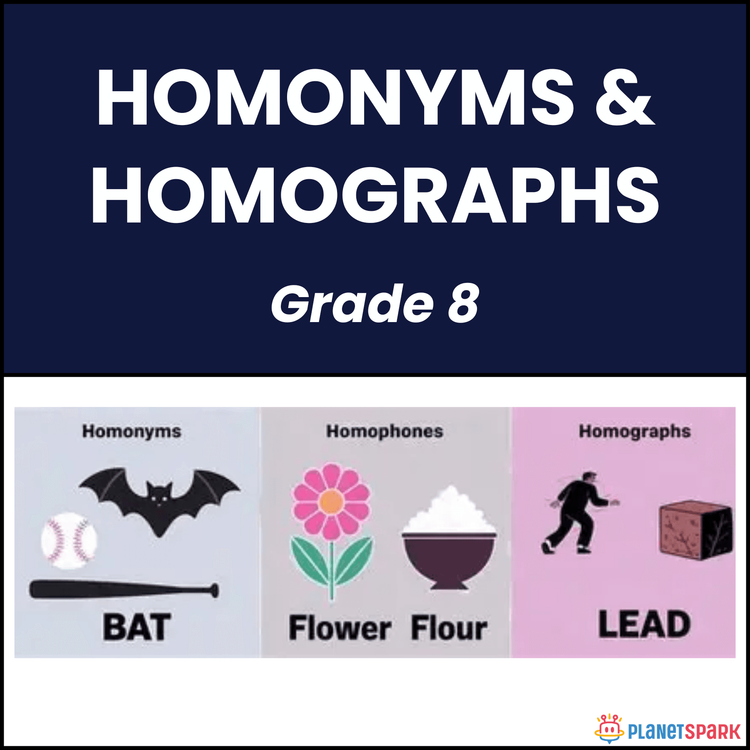
Class 8 English Worksheet on Homonyms Homographs
Words with Double Meanings: Homonyms & Homographs for Class 8
This Grade 8 worksheet on Homonyms & Homographs helps students strengthen vocabulary understanding, grammar accuracy, and contextual reading skills through engaging language activities. Learners practice identifying words that share spelling or pronunciation but carry different meanings, improving comprehension and communication confidence.
Why Homonyms & Homographs Matter in Grammar?
Homonyms and homographs are important vocabulary concepts that help students understand how context changes word meaning. Learning these word relationships improves reading comprehension, grammar accuracy, and language fluency. For Grade 8 learners, this topic is important because:
1. Homonyms and homographs improve contextual understanding.
2. Students learn how the same word can have different meanings.
3. It strengthens vocabulary precision and reading comprehension.
4. Learners improve grammar accuracy in speaking and writing.
5. Understanding word meaning through context supports confident communication.
What’s Inside This Worksheet?
This worksheet includes five grammar-rich activities that strengthen understanding of homonyms and homographs:
🧠 Exercise 1 – Multiple Choice Questions
Students choose the most appropriate word to complete each sentence correctly. This improves contextual understanding and grammar precision.
✏️ Exercise 2 – Fill in the Blanks
Students use a vocabulary bank to complete sentences with the correct words. This reinforces grammar recall and vocabulary application.
✔️ Exercise 3 – True or False
Students evaluate whether each sentence uses vocabulary correctly. This develops comprehension and critical thinking skills.
📋 Exercise 4 – Underline the Correct Word Usage
Students underline meaningful word combinations and identify verbs in each sentence. This improves grammar awareness and sentence analysis.
📝 Exercise 5 – Sentence Writing
Students create meaningful sentences using vocabulary prompts and question forms. This encourages practical language application and communication confidence.
✅ Answer Key (For Parents & Educators)
Exercise 1 – Multiple Choice Questions
1. When
2. What
3. There
4. Neither
5. Why
6. Is
7. Their
8. Your
9. Went
10. Where
Exercise 2 – Fill in the Blanks
1. Although
2. Was
3. What
4. Even
5. Why
6. Do
7. Because
8. Though
9. Where
10. Although
Exercise 3 – True or False
1. True
2. True
3. True
4. True
5. True
6. True
7. True
8. True
9. True
10. True
Exercise 4 – Underline the Correct Word Usage
1. went to the store
2. under the table
3. on the shelf
4. went to the store
5. attending the event
6. correct answer
7. meet me tomorrow
8. great review
9. reason for his behavior
10. weather nice today
Exercise 5 – Sentence Writing (Sample Answers)
1. When will you arrive at the meeting?
2. What book are you reading right now?
3. What is the reason you are late?
4. Which car is parked outside?
5. Why did you make that decision?
6. Where should we meet tomorrow?
7. Which is the best place to visit in this city?
8. How do you like your coffee?
9. Which team won the match yesterday?
10. What weather is expected tomorrow?
Help your child strengthen vocabulary accuracy and reading comprehension with engaging homonym and homograph activities designed to improve grammar confidence and communication skills.
Frequently Asked Questions
Homonyms share spelling or sound while homographs differ in meaning.
They improve reading comprehension and vocabulary understanding.
It uses examples and exercises to highlight differences in meaning.