
Class 5 Grammar Worksheet on Possessive Nouns

Class 5 Grammar Worksheet on Possessive Nouns
Possessive Nouns for Grade 5
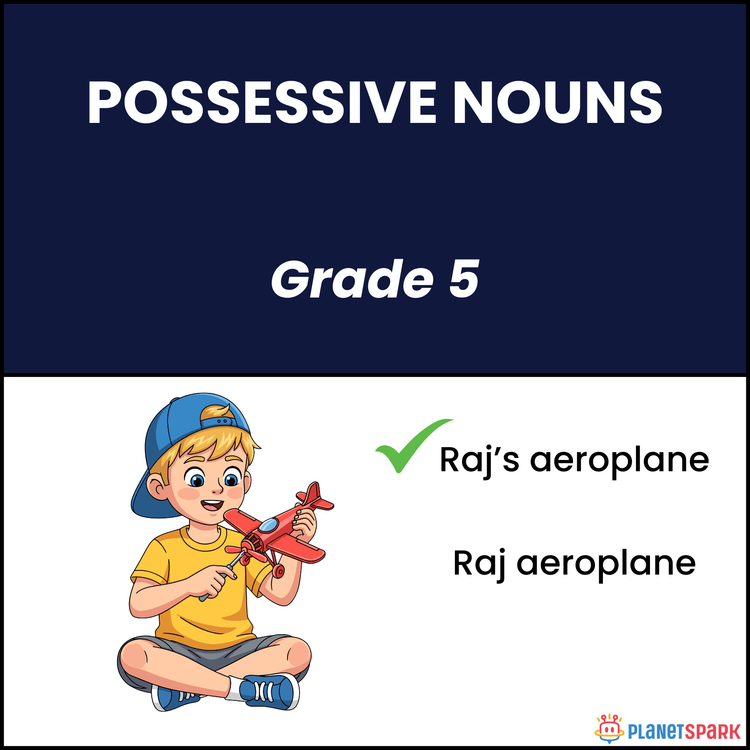
This Grade 5 worksheet focuses on possessive nouns, teaching students how to indicate ownership and possession in grammar. Possessive nouns show ownership by adding an apostrophe and "s" to a noun (e.g., the boy's book, the dog's tail). The worksheet provides a variety of activities such as multiple-choice questions, fill-in-the-blanks, matching, underlining, and paragraph writing. These exercises help students understand how to use possessive nouns in sentences and identify errors in their usage.
Possessive nouns are essential in forming clear, precise sentences where possession is being discussed. This worksheet provides students with practice in forming and using possessive nouns correctly, while also building their confidence in recognizing the differences between singular and plural possessive forms. The variety of tasks ensures students stay engaged while reinforcing their grammar skills.
Why Learning Possessive Nouns is Important for Grammar?
Mastering possessive nouns is important because:
1. It allows students to express possession in sentences clearly.
2. It strengthens their understanding of apostrophes and punctuation.
3. Possessive nouns are commonly used in writing and communication, helping students form more complex sentences.
4. Correct use of possessive nouns is necessary for Grade 5 grammar assessments.
What’s Inside This Worksheet?
Exercise 1 – Choose the correct possessive noun that fits the sentence:
This activity tests students' ability to choose the correct possessive noun form for given sentences.
Exercise 2 – Choose the correct possessive noun to fill the blank:
Students fill in the blanks with the correct possessive noun, practicing possession in different contexts.
Exercise 3 – Match each sentence to the correct possessive noun:
This task asks students to match each sentence with the appropriate possessive noun from a list.
Exercise 4 – Underline the incorrect possessive noun in each sentence:
In this exercise, students identify the incorrect use of possessive nouns and correct them.
Exercise 5 – Fill in the blanks in the paragraph with suitable possessive nouns:
Students will complete a paragraph with appropriate possessive nouns, helping reinforce the grammar concept in a contextual format.
Answer Key (for teachers and educators)
Exercise 1 – Choose the correct possessive noun that fits the sentence:
1. c) boy's
2. b) girl's
3. a) students'
4. b) cat's
5. a) friend's
6. c) teacher’s
7. a) school's
8. c) referee's
9. b) girls'
10. c) children's
Exercise 2 – Choose the correct possessive noun to fill the blank:
1. tail
2. bag
3. shoes
4. books
5. uniforms
6. fur
7. pen
8. helmets
9. feathers
10. notebooks
Exercise 3 – Match each sentence to the correct possessive noun:
1. teacher's
2. referee's
3. children’s
4. bird's
5. friend's
6. player's
7. boys'
8. girls'
9. cat's
10. school's
Exercise 4 – Underline the incorrect possessive noun in each sentence:
1. companies
2. children
3. teams'
4. managers
5. guests
6. authors’
7. actors
8. sisters
9. directors
10. engineers
Exercise 5 – Fill in the blanks in the paragraph with suitable possessive nouns:
1. principal's
2. her
3. his
4. students'
5. player's
6. team's
7. their
8. audience's
9. winning
10. them
Or
Answers may vary.
Help your child understand possessive nouns and improve their grammar skills with this interactive worksheet.
Frequently Asked Questions
To form possessive nouns, add an apostrophe and "s" to singular nouns, like "dog's toy."
For plural nouns that end in "s," like "dogs' bones."
They often forget the apostrophe or place it incorrectly in plural forms.