
Class 5 Worksheet on Introductory Comma Usage

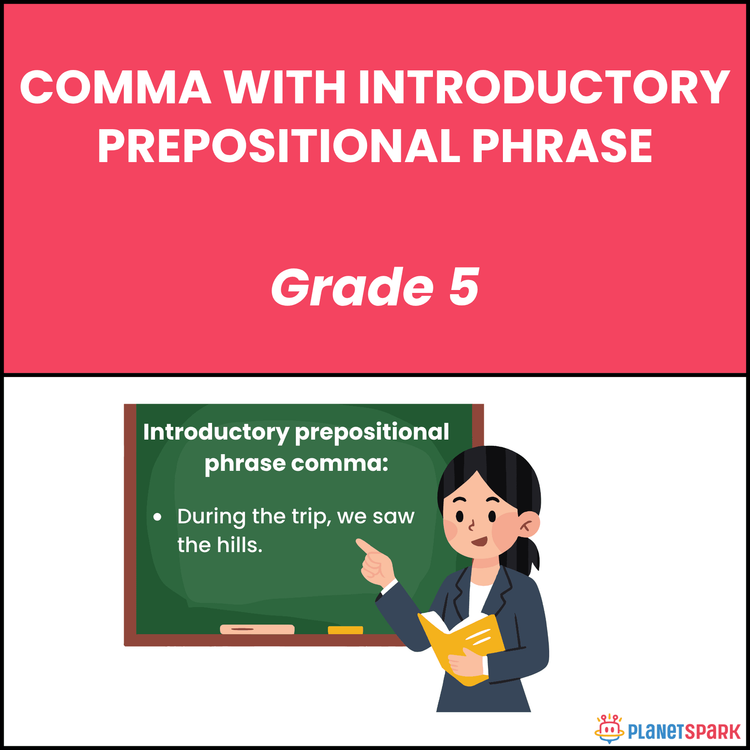
Class 5 Worksheet on Introductory Comma Usage
Comma with Introductory Prepositional Phrase: Mastering Grammar for Class 5
This Grade 5 worksheet focuses on the correct use of commas with introductory prepositional phrases. Students practice placing commas after introductory phrases such as “In the morning,” “After school,” and “Before lunch.” The worksheet includes various exercises like multiple-choice questions, true/false, fill-in-the-blanks, sentence rewriting, and paragraph writing to reinforce punctuation rules.
Why Comma Usage with Introductory Prepositional Phrases Matters?
Correctly using commas after introductory prepositional phrases helps in clarifying sentence structure. For Grade 5 learners, this is crucial because:
1. It improves sentence clarity by separating introductory elements from the main part of the sentence.
2. It enhances readability and ensures proper punctuation in writing.
3. Mastering this rule helps students build a strong foundation for more complex sentences in higher grades.
4. It boosts overall grammar skills, preparing students for more advanced language concepts.
What’s Inside This Worksheet?
This worksheet includes five engaging exercises designed to help students practice commas with introductory prepositional phrases:
Exercise 1 – Choose the Correct Sentence
Students select the sentence that correctly uses commas after introductory prepositional phrases. Example: “In the morning, we go to school.”
Exercise 2 – True or False
Students evaluate whether sentences correctly use commas after introductory prepositional phrases.
Exercise 3 – Fill in the Blanks
Students fill in the blanks with commas after the prepositional phrases.
Exercise 4 – Sentence Rewriting
Students rewrite sentences, adding commas where needed after introductory phrases.
Exercise 5 – Paragraph Writing
Students practice writing a short paragraph, using commas after introductory prepositional phrases correctly.
Answer Key (For Parents & Educators)
Exercise 1 – Correct Sentences
1. c) In the evening, we played.
2. b) After the match, we rested.
3. a) At night, the stars shine.
4. b) In the morning, we go to school.
5. c) Before lunch, we washed hands.
6. a) After school, we went home.
7. b) In the garden, flowers bloom.
8. a) On Sunday, we visit the temple.
9. b) At the park, children play.
10. c) During the trip, we saw the hills.
Exercise 2 – True or False
1. False
2. True
3. False
4. True
5. False
6. True
7. True
8. False
9. True
10. False
Exercise 3 – Fill in the Blanks
1. At the edge of the crowded marketplace, we spotted a street performer juggling knives.
2. During the last few moments of the presentation, the speaker paused for effect.
3. In the middle of the complicated experiment, the students realized their mistake.
4. Without any hesitation at all, she stepped forward to volunteer.
5. Near the entrance of the ancient temple, a guard was standing silently.
6. After several hours of continuous practice, the team improved their performance.
7. Across the wide river filled with boats, fishermen were casting nets.
8. Before the final results were announced, the audience held their breath.
9. On the top of the snow- covered mountain peak, a small cabin could be seen.
10. Throughout the entire journey across the desert, they faced extreme heat.
Exercise 4 – Sentence Rewriting
1. full stop- comma
2. colon- comma
3. semicolon- comma
4. dash- comma
5. sentence- phrase
6. joins- separates
7. ending- beginning
8. grammar- punctuation
9. wrongly- correctly
10. ending- introductory
Exercise 5 – Paragraph Writing
In the morning, Riya went to school. After lunch, she played with friends. In the evening, she finished homework and rested at home. After school, Riya and her friends went to the park. Before going out, she made sure to complete all her tasks. Around 4 PM, Riya took a short break to read her favorite book. In the afternoon, she helped her mom in the kitchen. At the same time, her brother was cleaning the garage. By the end of the day, she was tired but felt accomplished. After dinner, she relaxed with a movie. In the quiet hours, she reflected on her day, appreciating the balance she had found.
Help your child master comma usage in introductory prepositional phrases with easy-to-follow grammar exercises.
Frequently Asked Questions
Commas help separate introductory prepositional phrases from the main sentence for clarity.
Use a comma after a long introductory prepositional phrase or when the sentence starts with one.
By completing exercises where they add commas after introductory prepositional phrases in sentences.