
Class 3 Converting Statements to Questions Worksheet

Class 3 Converting Statements to Questions Worksheet
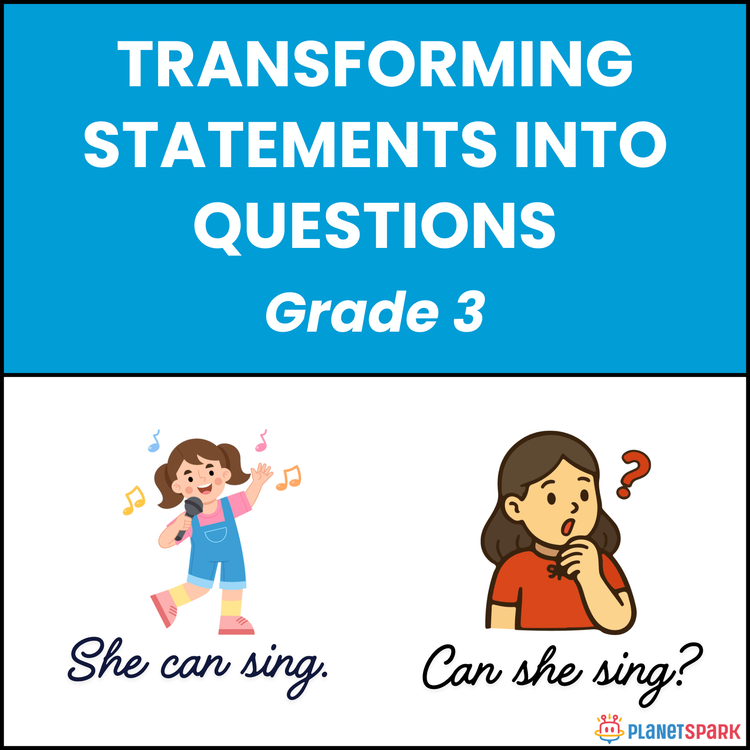
Transforming Statements into Questions: A Grammar Journey for Grade 3
This Grade 3 worksheet is designed to strengthen your child’s grammar skills by teaching them how to transform statements into questions. Understanding how to form questions is a crucial part of mastering English grammar and improves both written and spoken communication.
Transforming statements into questions helps children improve their sentence construction and question formation skills, which are essential for both written and verbal communication. It strengthens their understanding of grammar and encourages them to think critically about sentence structures.
Why Transforming Statements into Questions Matters?
Learning how to transform statements into questions is an essential grammar skill:
1. It builds the foundation for better sentence construction, conversation, and writing.
2. For Grade 3 students, this practice enhances their understanding of how sentences are structured and helps them develop fluency in speaking and writing questions.
3. Additionally, mastering this concept helps students prepare for more complex sentence structures as they progress in their education.
What’s Inside This Worksheet?
This worksheet contains a variety of engaging exercises to help students practice transforming statements into questions:
Exercise 1 – Choose the Correct Helping Word:
Students will practice choosing the correct helping verb (e.g., "Does", "Is", "Are") to form questions.
Exercise 2 – Choose the Correct Question:
In this section, students will pick the right question from multiple choices based on a given statement.
Exercise 3 – Rewrite Statements into Questions:
Students will be challenged to rewrite a set of statements as questions.
Exercise 4 – Fill in the Blanks with Suitable Words:
This exercise involves completing sentences by inserting the correct question words to transform the statements.
Exercise 5 – Write a Short Paragraph on "My Favourite Sport":
A creative writing exercise to help students apply their skills in sentence formation and practice expressing ideas.
These exercises are designed to reinforce the skill of transforming statements into questions in a practical, age-appropriate, and engaging way.
Answer Key (For Parents and Educators)
Exercise 1 – Choose the Correct Helping Word
1. Does
2. Do
3. Can
4. Are
5. Will
6. Do
7. Is
8. Do
9. Did
10. Was
Exercise 2 – Choose the Correct Question
1. a) Will Meera visit the library?
2. b) Can Ravi solve this puzzle?
3. b) Were the children playing outside?
4. c) Has Asha finished her drawing?
5. a) Is Raj playing with his cricket bat?
6. c) Have the boys cleaned the room?
7. b) Can Meenu sing a song?
8. a) Are the students reading quietly?
9. c) Am I doing a good job?
10. a) Does Rohit visit the science museum regularly?
Exercise 3 – Rewrite Statements into Questions
1. Does Anu play badminton after school?
2. Did Meera water the garden plants?
3. Is Mohit cleaning his cricket bat?
4. Do these shops sell a variety of milk items?
5. Has Isha opened the classroom window?
6. Have the puppies played outside?
7. Had Tara visited the city fair in June?
8. Are the bakers making bread?
9. Will the driver park the bus carefully?
10. Was Tina excited about the school trip?
Exercise 4 – Fill in the Blanks with Suitable Words
1. Is
2. Are
3. Have
4. Does
5. Can
6. Will
7. Am
Exercise 5 – Write a Short Paragraph on "My Favourite Sport"
Answer may vary.
Help your child master question formation today with a Free 1:1 Grammar Class at PlanetSpark!
Frequently Asked Questions
Change the word order or use auxiliary verbs like "do," "does," or "is" to create a question.
Direct questions ask for information directly, while indirect questions are more polite or formal.
It enhances communication skills and helps in understanding sentence structures.